UV unit replacement parts: lamps, quartz sleeves and pre-filter cartridges, on the maker's schedule
Rules from official regulators only How we source the rules How we label ads
On this page
- The rule that comes first: follow the maker's instructions
- The UV lamp
- The quartz sleeve
- The pre-filter cartridge
- Matching parts to your unit
- Who should do the work
- A simple parts log
- Questions to ask your maintainer
- Confirm the reference before placing an order
- Agree supply, fitting and household arrangements together
- Reconcile the log and any spares
- FAQs
- Sources
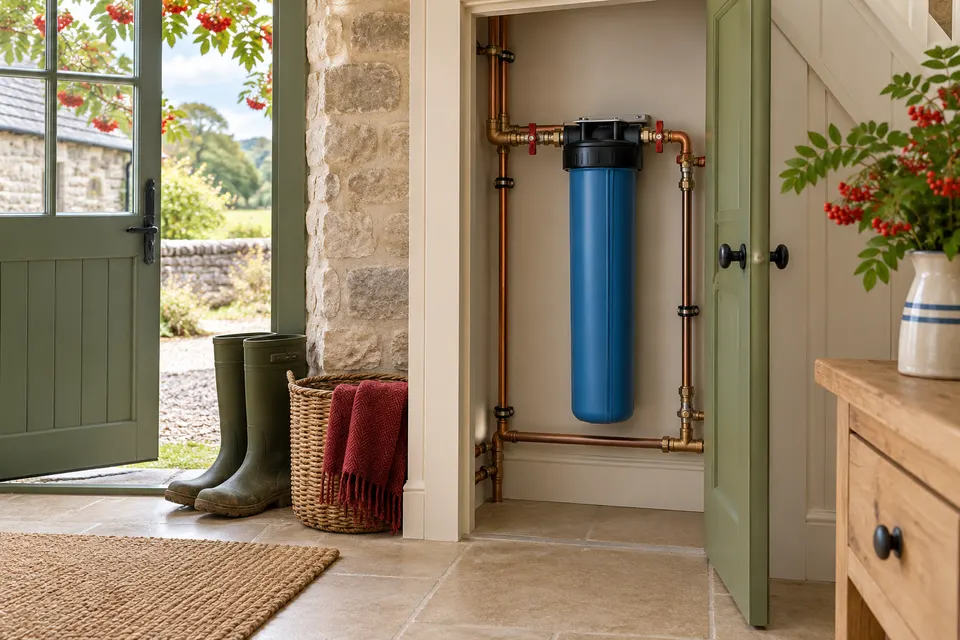
Many private-water treatment arrangements include a UV lamp, a quartz sleeve and pre-filtration. Their condition and maintenance needs differ, and not every installation uses the same filter arrangement. Appearance alone cannot establish effective treatment. This page covers what the official guidance says about each, how to match a replacement to your unit, and what to leave to a competent maintainer.
Regulatory scope: Drinking Water Inspectorate (DWI) guidance for England and Wales, checked on 24 October 2026. Scotland and Northern Ireland have their own regulators. There, ask your local authority what applies.
The rule that comes first: follow the maker's instructions
The DWI's record keeping and maintenance page says: "Equipment manufacturers' maintenance instructions must be followed as a minimum requirement." It also says your documents should detail the maintenance requirements, "including the criteria and regime for the replacement of any products or substances".
The DWI UV disinfection page says the same for UV: "Manufacturers' recommendations must be followed regarding installation, operation and maintenance."
So the schedule for your unit is the one in its manual, not a figure from a forum or a retailer listing. If you don't have the manual, find the make and model on the unit's label and ask the supplier or your maintainer for a copy before you buy anything.
The UV lamp
The DWI UV disinfection page says: "Typical lamp life is about 10 to 12 months, after which the output is about 70% of that of a new lamp." It also says "The intensity of UV radiation emitted decreases with lamp age."
A lamp that still glows can be past its useful life. The DWI's UV guidance for water suppliers says "UV lamps should be replaced once the maximum reduction in lamp output has been reached." That guidance is aimed primarily at public water suppliers, but the principle is the same at home: change the lamp on the maker's schedule, not when it goes dark.
What to record: the date the lamp was fitted, the lamp's part number and, if the unit has an hours counter, the reading.
The quartz sleeve
The lamp sits inside a clear quartz sleeve that the water flows around. The DWI says "The build-up of scale on the sleeves of the lamps will eventually reduce their transmittance." Its record keeping page also notes the need for regular checks on the operation of disinfection equipment.
Your manual should say how often the sleeve should be cleaned and when it should be replaced. Hard water can bring that forward, so ask your maintainer to note the sleeve's condition on each visit.
The pre-filter cartridge
UV performance depends on water quality, dose and flow, not simply whether water looks clear. Where Cryptosporidium is likely to be present and removal is required, the DWI specifies pre-filtration capable of achieving turbidity below 1 NTU before UV. That stated context matters: ask the competent designer or maintainer what treatment and monitoring your assessed supply needs. On many small supplies that pre-filtration is a cartridge: the DWI's physical removal of contaminants page says "Many small private supplies will rely on cartridge filters consisting of a woven or spun filter within a housing."
The DWI doesn't give a single replacement interval for cartridges. Its record keeping page calls for "regular cleaning of filters in line with the manufacturer's recommendations". A dirty supply after heavy rain can clog a cartridge faster than the manual's normal interval, so ask your maintainer what signs to look for on your system.
Matching parts to your unit
Lamps, sleeves and cartridges are often specific to a model, so check before assuming one will fit. Before you buy:
- Take the part number from the manual or the old part, not from the look of it.
- Check the lamp against the unit's model, not just its length. Lamps that look alike can differ in their fittings and power rating.
- Check the cartridge size and rating against the housing and what the manual or your maintainer specifies.
- Only use parts sold for drinking water UV units. The DWI says "UV units for ponds and fish tanks are not suitable for use on supplies for human consumption." Lamps and parts from those units don't belong in a drinking water system.
If you can't match a part with confidence, ask the unit's supplier or your maintainer.
Who should do the work
The DWI record keeping page says "Maintenance should always be performed by those deemed competent (trained and/or experienced and familiar with the equipment), ideally by the supplier's servicing contractors."
A UV unit runs on mains power. Changing a lamp or sleeve means isolating the power and the water and handling quartz glass. Unless the manual says the owner can do it and your maintainer has shown you how, leave it to them. Any electrical work must be done by a qualified electrician.
While the unit is off for maintenance, the water coming through is not being disinfected. The DWI notes that some owners use multiple units, or a treated water storage tank, to keep a supply running during maintenance. Ask your maintainer what your household should do during a part change, and write it into a private water outage plan before the day.
A simple parts log
The DWI UV page says "a maintenance log should be maintained by the owner to record details of maintenance carried out." For the UV lamp, the quartz sleeve and the pre-filter cartridge, write down:
- the part number
- the date it was fitted
- the next due date from the manual
- who fitted it
Record the next due date after the part is fitted. If you keep a spare lamp or cartridge, write its part number on the box.
Questions to ask your maintainer
- What does the manual say about the lamp, sleeve and cartridge intervals for this model?
- Does the unit have an hours counter or a lamp-change reminder, and what does it show now?
- Is the owner allowed to change the cartridge, and if so, how should the water and power be isolated?
- After a part change, does the supply need to be flushed or sampled?
For questions about the unit's alarms and what happens in a power cut, see questions to ask about your UV unit.
Confirm the reference before placing an order
Make a short identity sheet for each treatment component, with the exact model, available serial details and current manual. Read only labels accessible without opening equipment. If a controller or unit has changed, ask which documents and references now apply.
Send this to the supplier with a specific matching question. A similar model name or lamp length in a listing is not confirmation for your installation. Do not remove a component or open an enclosure to improve an online enquiry; ask the maintainer to establish unclear identity.
If a new reference differs from an old invoice, ask why. Keep the original, replacement and supplier's explanation together, including any changed instructions or associated components. Neither reference is necessarily wrong. Send the answer to the person doing the work and leave an uncertain order pending confirmation.
Agree supply, fitting and household arrangements together
Ask whether the maintainer will source parts or accepts owner-supplied items before you buy. A service package may include identification and associated work that a retail part alone does not cover. Having the correct part does not establish competence to fit it.
Keep a scheduled replacement separate from a fault enquiry. Ordering a consumable is not a diagnosis. If a fitting date or reading is unknown, say so; an unused spare's purchase date does not establish when the installed part was changed.
Before the appointment, ask what users should do while equipment is unavailable, what work record will follow and whether assessment, flushing or sampling is advised for this supply. For shared water, agree who passes the maintainer's instructions to affected users.
Where an authority has imposed a restriction, ask who confirms any change after work. Component replacement and permission to end an instruction are different matters. A parts receipt does not establish treatment performance.
Reconcile the log and any spares
After work, enter the actual fitted reference, date and provider from the report, along with the next requirement and its manual section or documented advice. Keep an owner's reminder distinguishable from the manufacturer's requirement.
If the competent provider recommends a spare, ask about packaging, storage and identification. Mark its confirmed application. Track unused, issued and returned items: a box sent to a service visit may come back partly used, or another component may have been selected. Check its contents before counting it as available again.
After an equipment change, ask whether remaining stock has a confirmed use or return route, and about appropriate disposal of old components. Do not transfer a visually similar spare to the new unit without confirmation.
Link the log to the sample-report guide and current professional advice where relevant. It records maintenance actions, not a certification of water quality or replacement for risk assessment and sampling.
FAQs
How often should a UV lamp be replaced?
Follow the manual for your model. The DWI says typical lamp life is about 10 to 12 months, after which the output is about 70% of that of a new lamp.
The lamp is still lit. Does it still need changing?
Yes, if it has reached the end of the maker's stated life. The DWI says the intensity of UV radiation emitted decreases with lamp age, so a lit lamp isn't proof that it is still delivering the dose.
Can I use a pond UV lamp in my drinking water unit?
No. The DWI says UV units for ponds and fish tanks are not suitable for use on supplies for human consumption.
Will changing the parts make my water drinkable?
Not on its own. UV is one step in a treatment system that should match the risks found in a risk assessment. If you aren't sure about your water, contact your council's environmental health team and get your water tested. See testing a private water supply.
Sources
Checked on 24 October 2026.