A private water UV unit: what the owner needs to know before a fault
Rules from official regulators only How we source the rules How we label ads
On this page
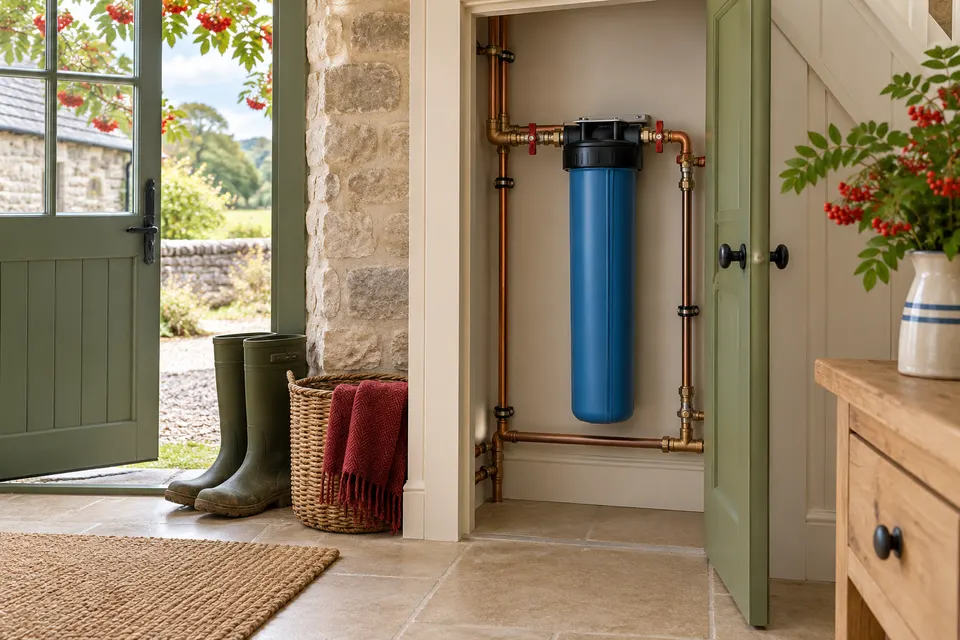
If your private supply has a UV unit, ask the maintainer to explain what it does, what it depends on and what happens when it stops working. A lamp housing and an illuminated display are not a complete operating plan.
Regulatory scope: Drinking Water Inspectorate (DWI) pages for England and Wales, checked on 24 October 2026. Use the relevant authority and guidance in Scotland and Northern Ireland. This page covers the owner's questions. It is not an instruction for designing, bypassing or repairing treatment equipment.
Identify the whole treatment arrangement
Record the UV unit's make and model and keep its manual. Ask for a simple diagram showing the source, any treatment before the unit, the unit itself and the supply beyond it, including other properties if the supply is shared.
The DWI's UV disinfection page says UV is a common method for disinfecting private supplies and that care is needed when choosing a unit. It says units must be designed for drinking water treatment and that units made for ponds and fish tanks are not suitable for supplies used for human consumption. It also says UV works only if the water is first of good quality, particularly low in turbidity, so ask what treatment comes before the unit.
Ask what the display and alarm mean
Have the maintainer explain the indicators and alarms on your actual unit, what you can safely observe, and when to call a professional. The DWI page strongly recommends a continuous UV monitor and an alarm or failsafe device, notes that they are not usually fitted as standard on point-of-use units, and says they are usually available as an extra. It adds that some monitors can stop the flow if the required intensity is not reached.
The more detailed DWI UV guidance lists the controls that water suppliers are expected to monitor, including water flow, lamp status and lamp operating times. It is aimed at public water suppliers, not at every domestic installation, so ask your specialist how monitoring is arranged for your own system.
Ask what happens in a power or lamp failure
The DWI UV page says that if power or the lamp fails and the flow of water is not automatically interrupted, the water produced will not be disinfected. It also says that lamp output falls as the lamp ages, with a typical lamp life of around 10 to 12 months, and that a lamp can look the same when its output has fallen, so a lit lamp is not necessarily a guarantee that the required dose is being delivered.
Ask the maintainer in writing:
- Does the unit shut off the water on lamp or power failure, or does water keep flowing?
- What should the household do with the water after an alarm or power cut?
- Who may restart or reset the unit, and what checks follow?
Do not bypass treatment, reset an unfamiliar alarm or open electrical or lamp assemblies to keep the water running. Do not improvise a boiling instruction for an unidentified problem. Ask the local authority or a specialist for specific advice. Treat the unit as mains-powered equipment and leave electrical work to a qualified electrician.
Tie maintenance to the exact unit
The DWI says manufacturers' instructions must be followed for installation, operation and maintenance, including not exceeding the maximum design flow rate, letting lamps warm up before water passes through, and cleaning and replacing lamps as recommended. It also says scale builds up on lamp sleeves and reduces transmittance, so they must be cleaned or replaced regularly, and that owners should keep the manuals and a maintenance log of work done and work scheduled. Ask who books the work, who receives the reports and who tells other users of a shared supply about a problem. An invoice should describe what was done rather than serving as a blanket approval of the whole supply. For the lamp, quartz sleeve and pre-filter cartridge in particular, see UV unit replacement parts on the maker's schedule.
Keep sampling and operation connected
Give the maintainer your sample reports, with dates and sampling points visible. A past sample and a present operating check answer different questions. See questions to ask about a sample report and preparing for a risk assessment visit.
FAQs
Does a UV unit make any private water supply suitable to drink?
No. The DWI says UV disinfection depends on good water quality and a sufficient dose, and that risk assessments are key to understanding how a UV system should be installed and managed. Ask your local authority or specialist what hazards your assessed system is meant to control.
How do I know if the lamp is still working properly?
The DWI says a lamp can look the same after its output has dropped. Ask the maintainer about intensity monitoring, alarms and the lamp replacement schedule in the manual for your model.
Sources
Checked on 24 October 2026.