Garden rainwater storage: separate roof yield from tank capacity
Rules from official regulators only How we source the rules How we label ads
On this page
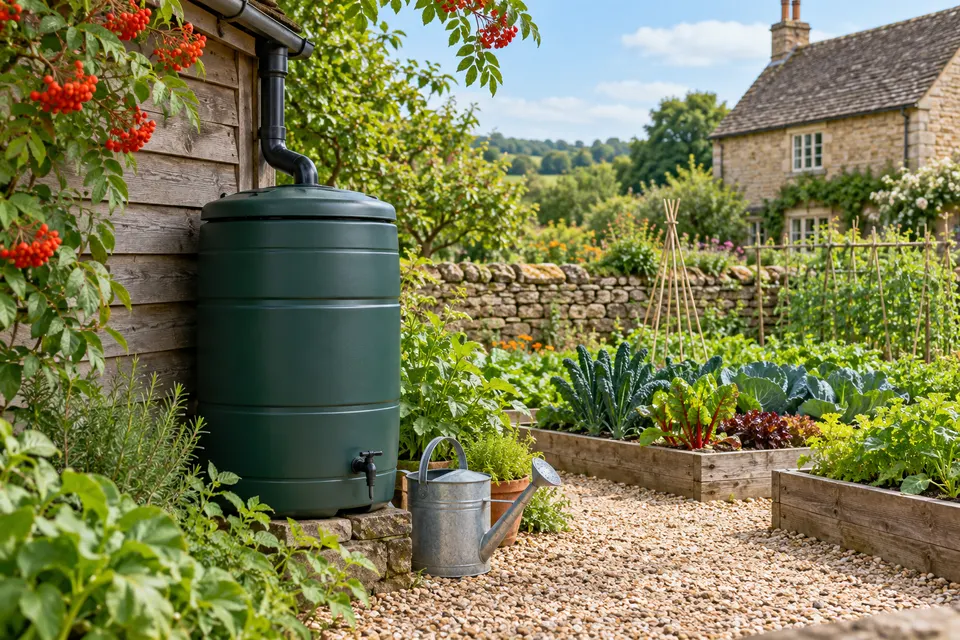
A large roof and a large water butt describe different parts of a garden water plan. Estimate the potential incoming volume, then check usable storage, where overflow goes and how the collected water will be used.
This page is about non-potable garden watering. It does not design a drinking water supply, a connection to household plumbing or flood protection. Sources checked on 24 October 2026.
A simple collection model
One millimetre of rain over one square metre of roof is one litre of water (0.001 m x 1 m² = 0.001 m³). For an invented example of 40 m² of collecting area and a 10 mm shower, the theoretical volume is 400 litres.
That is geometry, not a forecast. Actual collection depends on the effective roof area, losses, the gutter route, any diverter and the space left in storage. Ask the supplier or installer how those apply to your set-up.
Compare storage separately
A hypothetical empty 200-litre container cannot hold 400 litres just because the roof could deliver that much, and if it is already part full there is less room still. Decide where excess water goes before you connect anything. A nearby drain is not automatically the right destination: see check where the rainwater goes if the property has a septic tank or treatment plant. A volume example does not make a water butt flood protection.
Plan the equipment
The RHS guide to collecting, storing and using water says you need a gutter with a downpipe or a rainwater downpipe kit, that a filter keeps leaves and debris out of the butt, that butts should stand on firm, level stands or bricks so a watering can fits under the tap, and that several butts can be joined with connector kits or siphons. It recommends a close-fitting lid to keep out rain-borne spores of plant diseases and to discourage algal growth, and says butts should be cleaned yearly to prevent disease build-up and smells.
Use the product's installation instructions for fittings and support rather than improvising a stand under a heavy container, and keep children's access in mind.
Match the use to the source
The RHS says stored rainwater is not suitable for seedlings because it may carry damping-off diseases, and suggests a coarse spray setting on hoses connected to butts and draining hoses when not in use, because breathing in droplets from stagnant, warm water can pose a health risk. It also advises keeping gutters clear to reduce the risk of plant diseases. A debris filter does not make roof water drinkable, so keep the intended use explicit.
Put the container where you can reach it easily. A large capacity is of little use if you cannot get to the water or the collection route does not serve the bed you want to water.
Keep a small record
Note the collection area, the rainfall example you used, container capacity, usual fill level, overflow route, intended use and maintenance instructions. Update it if gutters or outbuildings change. The useful plan links a realistic source to storage and use, without turning a theoretical volume into a promise.
FAQs
How much rain does a roof collect?
One millimetre of rain on one square metre is one litre, so a 40 m² area and a 10 mm shower is 400 litres in theory. Real collection is lower and depends on losses, the gutter route and available storage.
Is rainwater from a butt suitable for seedlings?
The RHS advises against using stored rainwater on seedlings because it may contain damping-off diseases.
Is collected rainwater drinkable?
Not on the basis of this guide. A debris filter on a water butt is not evidence that the water is suitable for drinking.
Sources
Checked on 24 October 2026.